<
The Arctic and Antarctic: Challenges and Opportunities
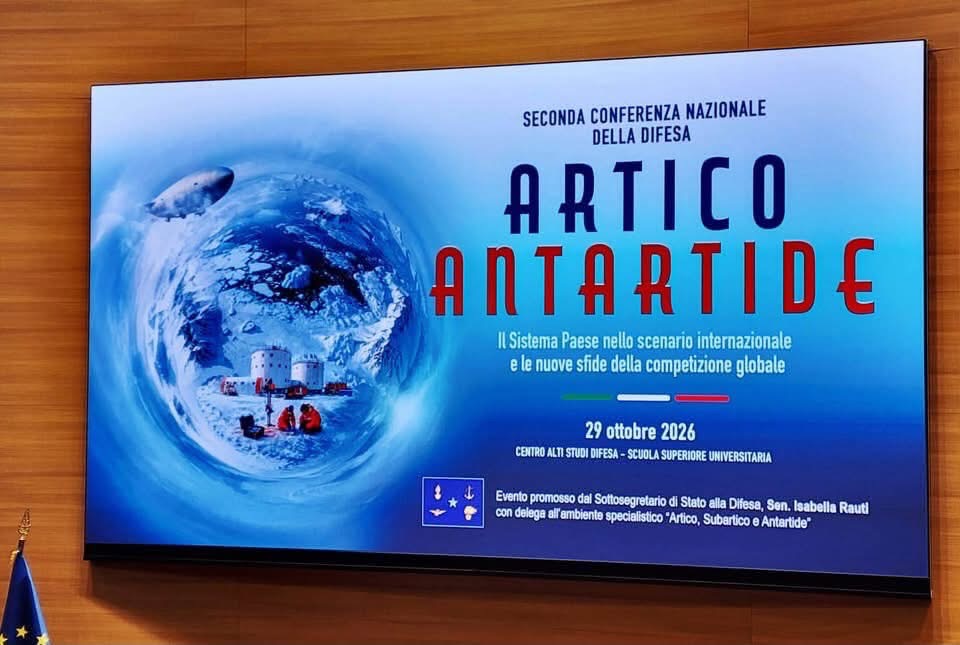
Second National Defence Conference
The polar regions are no longer peripheral to the international order. The gradual opening of new maritime routes, the availability of strategic raw materials and the growing military presence of major powers are turning the Arctic and Antarctic into pivotal theatres of global competition. The implications extend directly to Euro-Atlantic security, energy supplies and the ability of individual states to safeguard strategic infrastructure and domains.
This was the overarching picture to emerge from the Second National Defence Conference, “The Arctic and Antarctic: Italy’s National System in the International Arena and the New Challenges of Global Competition”, held on 29 October 2026, from 9.15 am to 5 pm, at the Centre for Higher Defence Studies – University School (CASD) in Rome, at the initiative of Isabella Rauti, Undersecretary of State for Defence.
The conference brought together representatives of public institutions, the armed forces, the diplomatic corps, the scientific community and industry. Discussions examined the strategic and operational implications of Italy’s presence in the polar regions, the role of scientific research and the prospects for international co-operation. At stake is a competition that extends well beyond the exploitation of resources and control of emerging trade routes: it directly concerns military security, the protection of infrastructure and the balance of international deterrence.
Italy and the Changing Geopolitical Landscape
In a message to the conference, Giorgia Meloni, Italy’s prime minister, highlighted the growing geopolitical significance of the two polar regions and their implications for national security and prosperity.
The Arctic and Antarctic are two areas of growing importance to the international order. Understanding them today means grasping the changing nature of global competition and its implications for the security, prosperity and interests of our nations. Climate change is opening up new maritime routes and making resources increasingly accessible, resources that are becoming ever more valuable to our economies. Meanwhile, competition for control of territory, infrastructure and critical raw materials is increasing the geopolitical and geostrategic weight of these regions.
For Italy, a Mediterranean nation and a bridge between Europe, Africa and the Gulf, the new Arctic routes could further enhance the centrality of the Mediterranean, strengthening its role as a link between the Atlantic and the Indo-Pacific. Secure maritime routes, diversified supplies and a firm presence across strategic domains are essential to our autonomy and competitiveness.
The challenge is to preserve these territories as areas of stability and co-operation. The Antarctic experience demonstrates the value of shared rules and multilateralism. What is needed, therefore, is a long-term vision capable of anticipating and managing change. Defence, diplomacy, scientific research, universities and industry must all contribute to a common strategy in which knowledge becomes the capacity to anticipate, innovation strengthens security, and industrial expertise generates growth. That is how Italy can play a leading role in shaping tomorrow’s international order.
Defence Minister Guido Crosetto stressed the need to change the perspective from which the polar regions are viewed, recognising their direct connection with national interests and the transformations reshaping international security.
The Arctic is one of the places where the future geopolitical, economic and military balance is taking shape. This reality requires us to change our perspective and understand that the threats to our security are manifold, constantly evolving and increasingly interconnected. New trade routes and competition for resources are tangible challenges, set to affect the role of the Mediterranean and our economy as well.
Italy has a long history of exploration and a presence that brings together military missions, scientific research and international co-operation. We must strengthen this commitment. No nation can face the challenges ahead on its own. Politics—with a capital P—has a duty to imagine the future, anticipate change and create the conditions to play a leading role in it. There are no distant scenarios when our security, our economy and the future of generations to come are at stake. If we fail to address tomorrow’s problems today, those problems will catch up with us.
Defence, Military Capabilities and Strategic Infrastructure
General Luciano Portolano, Chief of the Defence Staff, addressed the military implications in greater detail, identifying Arctic security as an established priority for both NATO and the European Union. The Atlantic Alliance has strengthened the co-ordination of its activities in the region, while Brussels is expected to contribute to the protection and resilience of strategic infrastructure. “The Alliance provides defence; the European Union helps make exposed systems more resilient”: it is through the complementarity of the two organisations, Portolano argued, that Italy can develop a distinctive role.
Extreme environmental conditions also represent a testing ground for military capabilities. Batteries, materials and satellite communications are subjected to stresses that can compromise the efficiency of systems. This has led to the identification of three priority areas: the human factor, surveillance and protection capabilities, and logistics.
The requirements include well-trained personnel, integrated sensors spanning the full spectrum from space to the seabed, secure communications with allies, and a logistics chain capable of ensuring operational deployment and support. The expertise of the Italian Armed Forces and COSMO-SkyMed technologies already provide an important foundation, which must be integrated into future polar capabilities.
Economic Competition and Natural Resources
The economic dimension of competition was explored by Mads Qvist Frederiksen, executive director of the Arctic Economic Council (AEC), who drew attention to the concentration of energy, fisheries and mineral resources in the region.
Interest is no longer confined to states bordering the Arctic: European, Asian and Middle Eastern countries are updating their strategies to secure a presence and access to resources. Fisheries, energy and critical raw materials are fundamental sectors for the green and digital transitions, but also for the defence industry. A significant proportion of Europe’s liquefied natural gas comes from Norway, while investment in energy and mining continues to grow.
Frederiksen nevertheless cautioned against reducing the Arctic’s future to the opening of new commercial corridors. There is, he noted, insufficient evidence to regard climate change as an automatic precondition for the emergence of a new maritime highway. Above all, “the cheapest form of security remains investing in people”: the protection of local communities, employment opportunities, and food and energy security must accompany any development strategy.
Space Technologies and Scientific Co-operation
Turning to space technologies, Ezio Bussoletti, chairman of e-GEOS, highlighted the expertise Italy has built up over more than four decades. Space, now recognised by NATO as the fifth operational domain, has become an indispensable component of surveillance and monitoring capabilities.
Without satellites, even the activities of the Italian Navy and territorial monitoring would be severely constrained. Bussoletti likened the sector to “the first violin in an orchestra”, emphasising the need to integrate space expertise with hydrographic, military and scientific capabilities.
Among Italy’s leading assets is COSMO-SkyMed, which is increasingly in demand abroad. Consolidating this advantage, he added, requires investment in training. The master’s degree in Space Economy launched in partnership with LUISS Business School and the Armed Forces is part of this effort.
Agostino Pinna, Italy’s Special Envoy for the Arctic, highlighted the strengthening of Italy’s presence in the region, reflected in the substantial Italian participation at the latest Arctic Circle Assembly, held in Reykjavík from 8 to 10 October. Among the Italian institutions and organisations in attendance, the Ministry of Defence participated for the first time with its own dedicated session.
Recent initiatives have included the centenary of the flight over the North Pole, commemorated jointly with Norway, which reaffirmed the value of international collaboration. “Scientific co-operation is a powerful instrument of international presence, capable of building lasting relationships.”
The next milestone will be the 30th anniversary of Italy’s base in Ny-Ålesund, on Svalbard, which is to be marked through an international event involving the oceanographic vessel Laura Bassi.
Ambassador Pinna also highlighted the evolution of the geopolitical and geoeconomic landscape, without overlooking the environmental dimension. While security is an immediate priority, climate change remains one of the greatest long-term threats.
Scientific co-operation must therefore be grounded in shared principles: “freedom of research, transparency and accessibility of the data collected”, while exercising caution towards partnerships that are politicised or scientifically unreliable.
<
Mapping the Arctic and Monitoring Climate Change
The contribution of the Italian Navy’s Hydrographic Institute was presented by Rear Admiral Fabrizio Orengo, who outlined the achievements of iNORTH, a scientific co-operation platform bringing together the Ministry of Defence, the Italian Navy, universities and research institutions.
Over the course of a decade, through activities aboard the vessel Alliance, the project has developed six operational strands, ranging from seabed mapping and environmental monitoring to technological experimentation and crew training.
Less than 30 per cent of the Arctic seabed has been mapped.
Orengo recalled that expeditions around Svalbard have covered more than 7,000 nautical miles and mapped over 32,000 square kilometres, involving more than 150 researchers, five national institutions, four universities and seven international and industrial partners.
The data are shared with the international scientific community and provide a foundation for future research and navigational safety activities. The project will continue, supported by the arrival of new naval vessels designed for deployment in polar environments.
The picture was completed by Giuliana Panieri, director of the Institute of Polar Sciences at the National Research Council (CNR), who presented the findings of a study combining data from 27 satellite missions to reconstruct ice loss between 1979 and 2023.
The total amounts to 11,000 billion tonnes, equivalent to a cube of ice measuring 23 kilometres on each side. Melting has contributed to a rise of more than three centimetres in the global mean sea level, with differing consequences across geographical regions.
“The Earth system is deeply interconnected”, Panieri observed, drawing attention to the particular exposure of a country such as Italy, with its extensive coastline.
Polar research, she added, is not merely about generating data, but also about “trust, collaboration” and building relationships with indigenous populations. Italian activities, including seabed maps produced by the Navy, are now being used by the international scientific community.
The European Union’s Arctic Strategy
The European Union’s new Arctic strategy, adopted on 20 October, was the focus of the address by Claude Véron-Réville, the EU’s Special Envoy for the Arctic. The document, she explained, represents a significant political milestone, bringing Italy’s Arctic policy, for the first time, within the framework of a comprehensive strategy in response to a profoundly altered geopolitical and security environment.
Four priorities have been identified: security and resilience, tackling climate change, economic development, and the prosperity of local communities. More than half a million of the Arctic’s approximately four million inhabitants are EU citizens.
The strategy also introduces the concept of the Northern Neighbourhood, a framework for co-operation intended to strengthen relations with partners such as the United Kingdom, Canada and the United States.
Russia’s military build-up, its co-operation with China, hybrid threats and the activities of the shadow fleet are, according to Véron-Réville, sources of growing instability. Critical infrastructure is particularly exposed, beginning with undersea cables, which are essential to international communications.
Europe’s response must therefore focus on “situational awareness”, resilience, preparedness and maritime security.
It is precisely the relationship between economic competition and the military dimension that reveals one of the Arctic’s most significant transformations. Russia’s and China’s presence cannot be understood solely through energy investment, seabed exploitation or the search for new routes.
The region’s geography has direct implications for strategic deterrence: a missile attack launched from the Arctic towards North America would drastically reduce warning times and interception opportunities, leaving US territory exposed to a particularly acute vulnerability. This is one of the factors explaining Washington’s attention to the Arctic theatre and the growing centrality of surveillance and defence systems.
The issue of Western cohesion adds another layer of complexity. Europe’s position remains shaped by views that do not always converge with those of the United States, with differences extending to security, relations with Israel and the very definition of the West’s strategic interests.
At a time when Russia and China are developing an increasingly close convergence of interests, ambiguity in Europe’s position risks undermining its ability to formulate a common response. The issue concerns not merely military co-ordination, but the political cohesion of the Euro-Atlantic alliance itself.
Antarctica: Science, Logistics and Defence
The third session shifted the focus to Antarctica, where Italy’s model is based on an established partnership between scientific research, logistics and military support.
Nicola Casagli, president of the National Institute of Oceanography and Applied Geophysics (OGS), recalled the institute’s longstanding activities in the polar regions and the role of the icebreaker Laura Bassi, Italy’s only vessel equipped for oceanographic research in polar environments.
The vessel operates in support of the National Antarctic Research Programme, in collaboration with the CNR and ENEA. The Southern Ocean plays a decisive role in ocean circulation, heat exchange and carbon dioxide absorption, with effects that extend as far as the Mediterranean.
The Laura Bassi is a genuine “floating scientific laboratory”, enabling researchers to study marine ecosystems, interactions between the ocean and ice sheets, and the processes contributing to rising sea levels.
Casagli emphasised the need for sustained investment, technological upgrades and qualified personnel, noting that co-operation with the Defence Ministry is essential to ensuring the safety and logistical support of expeditions.
General Carlo Di Somma, chairman of the Joint Armed Forces Steering Committee for the Arctic, Sub-Arctic and Antarctic, addressed the operational conditions that make research possible.
When we talk about security, we are talking first and foremost about people’s safety.
Di Somma highlighted the need to ensure access, continuity of operations and logistical reliability.
In Antarctica, the Armed Forces provide support through the Boulder Clay airstrip, aircraft and personnel from the Italian Air Force, alongside contributions from other military branches. A similar role is played by naval platforms, including Alliance, Laura Bassi and Gaia Blu, each engaged in scientific activities with different capabilities and functions.
Di Somma also recalled the Army’s High Altitude Camp project, developed by the Alpine Training Centre as an environment for training and testing equipment and procedures for operating in conditions of isolation and extreme cold.
Infrastructure and the National Antarctic Research Programme
The logistical and infrastructural dimension was explored by Francesca Mariotti, director of the Italian National Agency for New Technologies, Energy and Sustainable Economic Development (ENEA).
Since the establishment of the National Programme, the agency has been responsible for logistics, as well as the construction and maintenance of facilities at the bases. ENEA built the Mario Zucchelli Station and contributed to the construction of Concordia Station on the Antarctic Plateau through an agreement signed in 1993 with the French Institute for Polar Research and Technology.
This is a complex undertaking, beginning with the selection and preparation of the approximately 200 people who travel to the continent each year. They undergo rigorous medical examinations and assessments of their physical and psychological fitness.
The agency must also ensure that the bases remain operational, providing everything from scientific equipment and laboratory materials to food and consumer goods. “An ongoing effort, carried out over the past 40 years”, Mariotti emphasised, drawing attention to the contribution of the personnel who keep the expeditions running.
Silvano Onofri, chairman of the National Scientific Commission for Antarctica, reviewed the organisation of the National Antarctic Research Programme (PNRA), established under the 1985 law and based on co-operation between the CNR, ENEA and OGS, with contributions from the Armed Forces.
The three-year programme, proposed by the Commission to the Ministry of Universities and Research, is translated into annual implementation plans.
Onofri also recalled his first personal experience in Antarctica, in 1988, when he spent five months working alongside Mario Zucchelli, then expedition leader. The experience gave him first-hand insight into the expertise provided by the Armed Forces, from Alpine troops to military divers.
At the heart of the system remains the Antarctic Treaty of 1959, which dedicates the continent to peace and science and provides the foundation for international co-operation.
A Long-Term Vision for the Polar Regions
In the closing session, Olafur Ragnar Grímsson, chairman of Arctic Circle and former president of Iceland, acknowledged Italy’s potential to play a significant role in the emerging international dynamics.
In his view, the conference itself, in terms of both its level and participation, represented an initiative still uncommon in the international arena. He nevertheless cautioned against underestimating how much remains to be understood about the polar regions, which have long stood at the margins of political and intellectual priorities.
The Arctic, he explained, must be understood through its distinct geographical areas: the American region, represented by Alaska; the Canadian Arctic; the Nordic Arctic; and the Russian Arctic. The latter accounts for approximately half of the entire region.
“Russia is itself an Arctic power”, Grímsson recalled, emphasising that Moscow had already attached strategic importance to the region before the invasion of Ukraine.
The transfer of Arctic responsibilities to the ministry overseeing the Far East also reflected a desire to consolidate an economic axis with Asian powers, particularly China and India, through energy, mining and commercial interests. This convergence is set to have an increasingly significant impact on the global balance of power.
In his closing remarks, Undersecretary Isabella Rauti described the second conference as a “qualitative leap” compared with its predecessor, citing the depth of the contributions and the participation of the international community.
Two strategic elements had emerged: Total Defence, understood as the integration of civilian and military dimensions, institutions, industry, universities and research centres; and the need for a shared national strategy founded on co-operation, dialogue and scientific diplomacy.
Russia’s invasion of Ukraine has profoundly altered the geopolitical landscape, bringing security back to the centre of Arctic strategy. The accession of Sweden and Finland has made NATO more Arctic, while Greenland has assumed greater importance in the Euro-Atlantic balance.
The new European strategy, alongside environmental protection and the fight against climate change, also places security at its core, from maritime and satellite surveillance to the protection of undersea cables.
The aim is not to militarise the region, but to ensure defensive deterrence and credible protection capabilities.
The conference forms part of the path set out by the Ministry of Defence through the operational activities of the Armed Forces, institutional and scientific initiatives, and its contribution to Italy’s Arctic Policy, presented in January 2026.
The objective is to build a national polar architecture capable of bringing together the expertise, capabilities and resources of the Defence Ministry, public institutions, research bodies and industry.
The strategy envisages an Italian presence that goes beyond participation in scientific activities, developing instead into a lasting capacity to contribute to international security and the balance of power.
Rome, CASD | October 29, 2026
ItaliensPR – Sandroni & Staff