POLAR KNOWLEDGE, GLOBAL CONSEQUENCES: FROM EXTREME ENVIRONMENTS TO A CHANGING EARTH
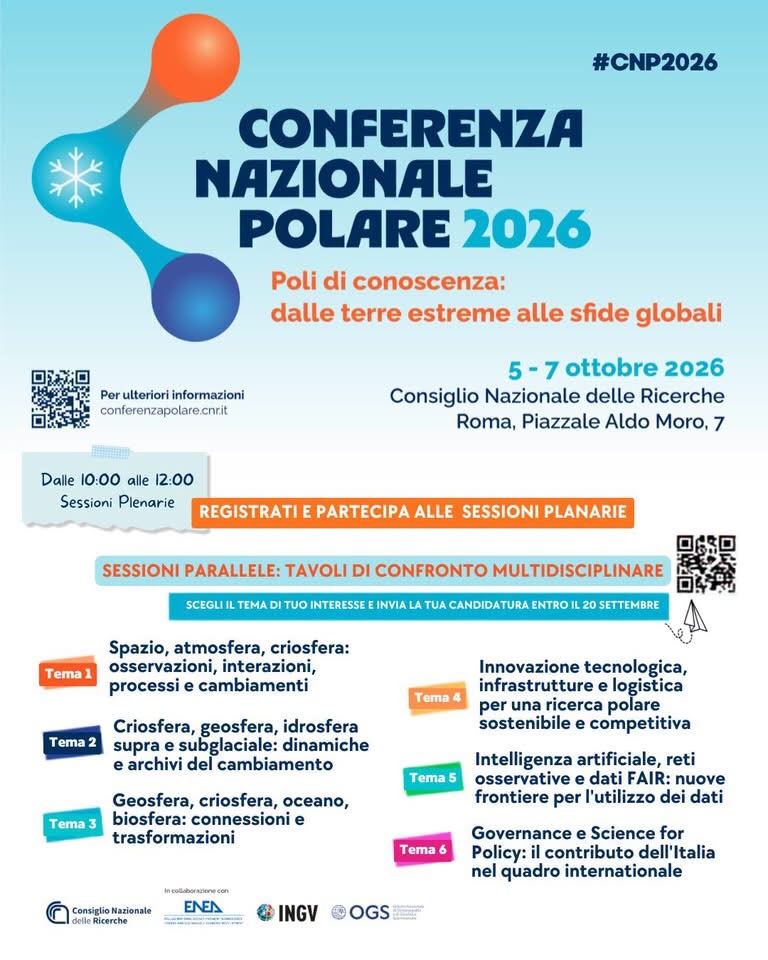
The first National Polar Conference, “Poles of Knowledge: From Extreme Lands to Global Challenges”, brought Italy’s polar research community together at the headquarters of the National Research Council (CNR) in Rome, linking Arctic, Antarctica, the Third Pole and mountain glaciers. It prepares Italy’s contribution to the Fifth International Polar Year, 2032–2033, and a White Paper.
Francesco Petracchini, Director of the CNR Department of Earth System Sciences and Environmental Technologies, set the frame:
“Although the Arctic, Antarctic and Third Pole may seem remote, the changes affecting them produce effects on a global scale.”
CNR President Andrea Lenzi added:
“The National Polar Conference aims to strengthen our capacity to work as a system and connect expertise, fostering dialogue between the scientific community, research institutions and public institutions.”
Francesca Mariotti (ENEA), Fabio Florindo (INGV) and Nicola Casagli (OGS) also intervened on cooperation and multidisciplinary research.
THE EARTH AS AN INTERCONNECTED SYSTEM
For Gary Wilson, President of the Scientific Committee on Antarctic Research (SCAR), the starting point is the interconnectedness of the planet:
“The Earth system operates as an interconnected system. Melting ice drives sea-level rise; the Southern Ocean connects all the oceans and connects the surface ocean with the deep ocean, playing a major role in moving heat around the planet.”
Antarctica is changing rapidly:
“The nature of the ice is changing. We have seen extreme minima in Antarctic sea ice, extreme temperatures in both summer and winter, and changes in species. So the way we used to think about Antarctica is not how we need to be thinking about it now.”
Wilson linked the Fifth International Polar Year to a more extensive observing system. The Southern Ocean is also our biggest carbon sink, accounting for around 40% of the ocean’s uptake of anthropogenic carbon, although its carbon sink varies substantially. Understanding why remains a key scientific challenge.
Camilla Brekke, Director of the Norwegian Polar Institute, described the polar regions as “the Earth’s cooling system”, now under rapid pressure from rising air and seawater temperatures. In Svalbard, marine-terminating glaciers have retreated by around 200 metres on average over the last two years.
“Fieldwork is becoming more difficult, more dangerous and harder to carry out in the places where we need observations.”
Brekke called for automatic observing systems and remote sensing alongside fieldwork. The most important drivers are the climate gases produced by humans and changes in land use. At the same time, she stressed that climate adaptation must now also be considered.
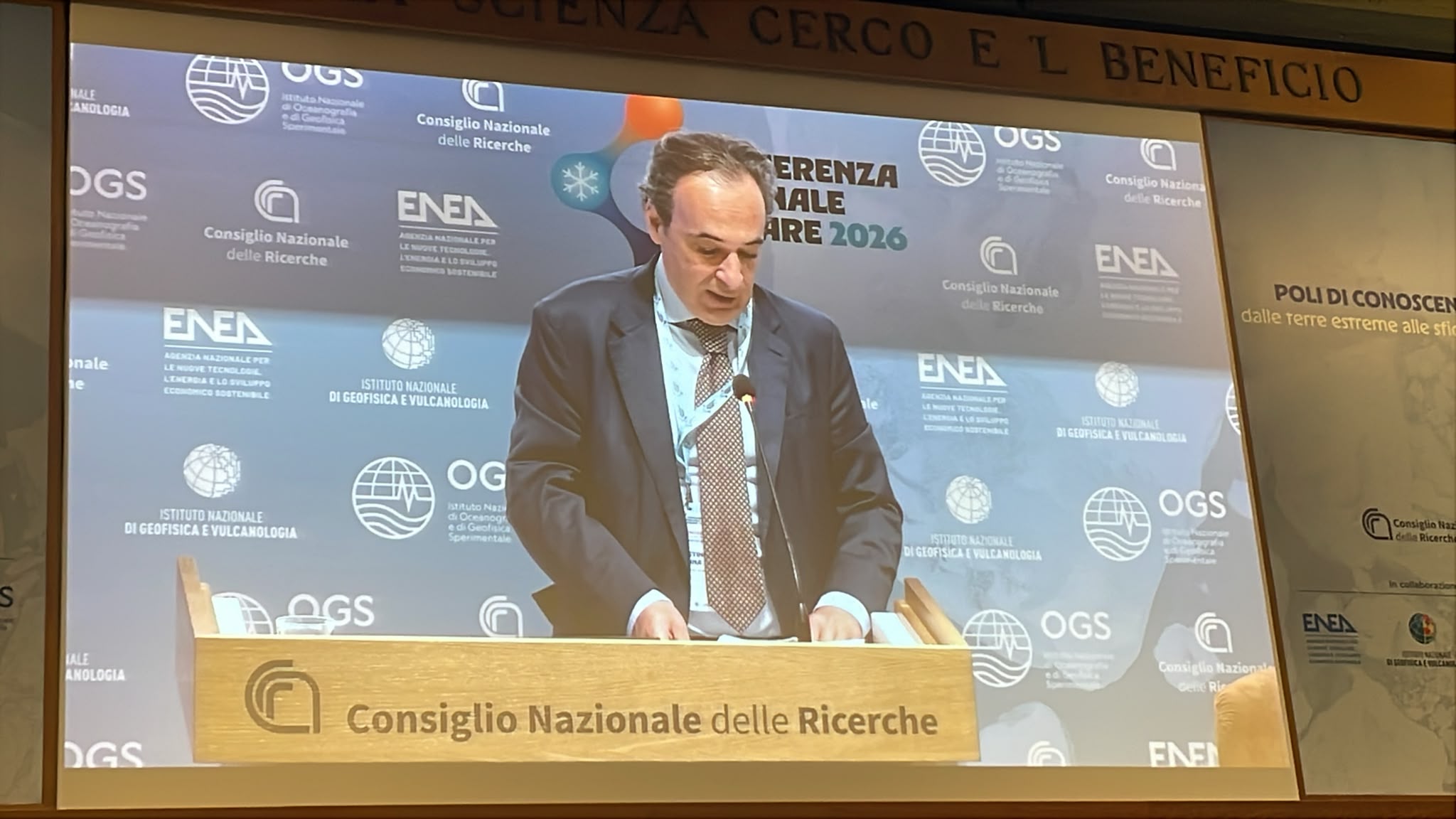
Ambassador Agostino Pinna, Italian Special Envoy for the Arctic.
THE SCIENTIFIC CORE: OBSERVING A CHANGING POLAR SYSTEM
The scientific core came from Giuliana Panieri, Director of the CNR Institute of Polar Sciences:
“Processes, interactions and knowledge gaps still limit our ability to explain the changes we are seeing today and to anticipate what might come next.”
Her argument is that the polar regions cannot be treated as separate laboratories:
“We cannot study the Arctic, Antarctica, the Third Pole and mountain glaciers separately. The Earth system is deeply interconnected and what happens in these apparently remote areas produces concrete effects on our daily lives.”
The scale is visible in the ice sheets. An assessment supported by the European Space Agency (ESA) and the National Aeronautics and Space Administration (NASA), combining 42 independent estimates from 27 satellite missions, found that between 1979 and 2023 Greenland and Antarctica lost about 11.3 trillion tonnes of ice, contributing more than three centimetres to global mean sea-level rise. Around 84% of the loss was linked to accelerated glacier dynamics and increased ice discharge into the ocean.
For Panieri, the figure also shows how polar knowledge is produced:
“No single instrument, discipline or country could have produced this picture alone.”
Satellite observation provides the global view, but field measurements remain essential:
“The global scale gives us an overall picture, but it is targeted field observation that allows us to verify and understand phenomena.”
“If you interrupt a time series, that information gap can no longer be recovered.”
OBSERVATION, DATA AND DIGITAL TWINS
Martin Wearing, Digital Twin Earth specialist at the European Space Agency’s European Space Research and Technology Centre (ESA-ESRIN), described Sentinel and CryoSat observations, with CRISTAL and CIMR expected to reinforce climate monitoring.
Stefano Nativi, Scientific Attaché at Italy’s Permanent Representation to the European Union, focused on Digital Twin Earth.
Narelle van der Wel, Head of the Cryosphere Monitoring, Prediction and Services Unit at the World Meteorological Organization, stressed stronger observation systems and global data sharing:
“The next International Polar Year 2032–2033 and the Decade of Cryosphere Sciences represent a strategic opportunity to mobilise resources and improve our understanding of the processes underway.”
The objective is practical services, including climate forecasts and warning systems.
FROM SCIENCE TO GLOBAL GOVERNANCE
Salvatore Aricò, Chief Executive Officer of the International Science Council, widened the frame:
“The polar regions can no longer be considered an exclusively scientific issue, because they directly affect the economy, geopolitics and global society.”
He called for natural and social sciences and Indigenous knowledge to be integrated from the earliest stages of research, with the poles recognised as a common heritage of humanity.
Italy’s role in the Antarctic Treaty System and as an Arctic observer, cooperation, security and strategic interests were also discussed, alongside change across the Third Pole — Himalaya, Karakoram and Tibetan Plateau. The International Polar Year 5 National Committee, with Stefania Gilardoni, Paola Rivaro, Gianluca Bianchi Fasani and Mauro Mazzola, coordinates Italy’s contribution.
TOWARDS THE FIFTH INTERNATIONAL POLAR YEAR
Panieri’s conclusion brings the different strands together:
“Technology cannot replace scientific judgement or field observation. The challenge is to integrate them, quantify uncertainty rather than hide it, and make knowledge transparent, interoperable and genuinely reusable.”
The conference concluded with a positive multidisciplinary discussion to identify the main priorities and recommendations for the final conclusions. The results will feed into the White Paper and be presented at the institutional plenary on 7 October, alongside the Ministers of Foreign Affairs and International Cooperation, Defence, and University and Research, who promoted and signed Italy’s National Strategy for the Arctic in January 2026.